Chestnuts Guide | Varieties, Roasting and Recipes
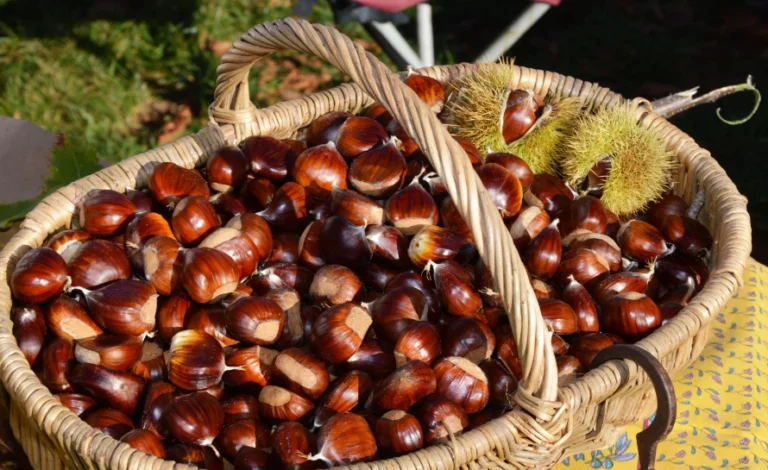
I get far more excited about chestnut season than any adult should probably be! The moment the first spiky burs start dropping onto the lanes around here, I’m already planning what to make. I eat them every way I can: blended into a silky soup, roasted chestnuts until the shells crack and blacken, and boiled when I’m too impatient to wait for the oven.
It’s sweet without being sugary, soft and a little floury, somewhere between a baked sweet potato and a toasted hazelnut. The taste is just like nothing else!
And yes, peeling roasted chestnuts is a pain, although it is a bit easier with a chestnut knife. By hand, you end up with black fingertips, and because I can never wait for them to cool down, I burn my fingers all the time. But I wouldn’t swap it for anything, that little battle is part of the pleasure.
If chestnuts make you as happy as they make me, you’ll want to know a bit more about them. Consider this your complete guide to one of autumn’s best things.
Table of Contents
L’arbre à pain: the chestnuts history in France
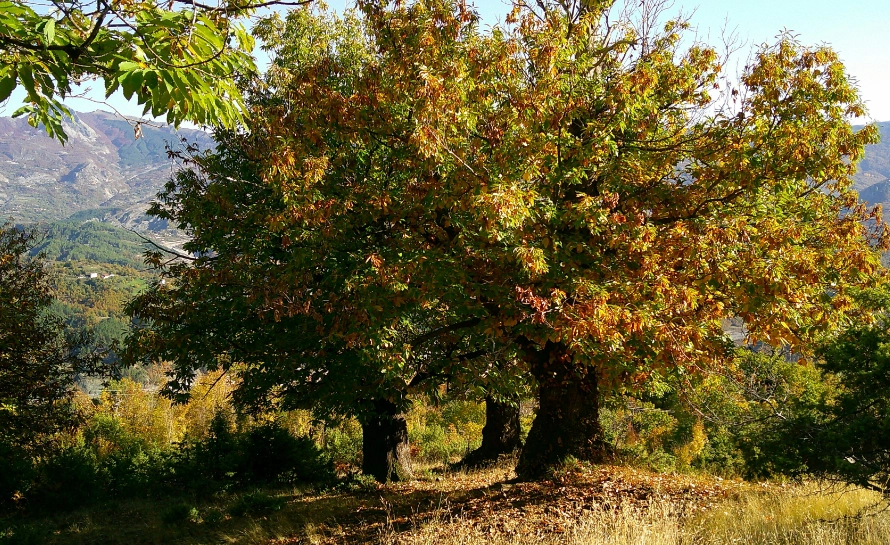
These days chestnuts feel like a treat, but for a very long time they were what stood between mountain families and an empty stomach. From the Middle Ages, chestnut orchards spread across the slopes of the Ardèche and the Cévennes, reaching their peak in the 19th century, and in the steep, poor, acidic soils of those hills, the Limousin and Corsica, they thrived where wheat struggled. That’s how the chestnut tree earned its nickname, “l’arbre à pain”, the bread tree, and in the Ardèche chestnuts were even used as currency, just like wheat or salt!
Families ate them fresh in autumn and dried the rest to last through the year. In the Cévennes they were dried for three to six weeks over a slow, smoky, flameless fire in little stone drying houses called “clèdes”, then shelled and stored away. Dried chestnuts went into soups and porridges and were ground into flour for breads, flatbreads and polenta. In Corsica, chestnut flour mattered so much that the island still has its own AOP for it.
In the 20th century, people left the mountains for towns and factories, and with cheap bread and potatoes available to everyone, chestnuts lost their place on the daily table and picked up a reputation as old-fashioned peasant food. Can you imagine?
American readers will know a sadder version of this story. The American chestnut once filled the forests of the eastern United States, until a fungal arrived in the early 1900s and wiped out billions of trees within a few decades. It’s why most chestnuts in American stores today are imported, often from Italy or Asia.
Thankfully France has a slightly better ending. Growers worked to revive the old chestnut groves, and the AOPs eventually gave the best chestnuts the protected status they deserve. This year the Ardèche is celebrating 20 years of its chestnut appellation, and I’d say chestnuts have never been more loved.
Châtaigne or marron? Toxic or edible?
In English, a chestnut is simply a chestnut. In France we have two words for it, châtaigne (“shah-TEN-yuh”) and marron (“mah-RON”), and you’ll see both all over French markets, menus and jar labels, so it’s worth knowing what they mean. It is a bit confusing, but I hope everything will be clear after reading this article!
A châtaigne is the everyday chestnut that falls from the sweet chestnut tree. A marron comes from the same species of tree, but from selected varieties that give a premium chestnut, a bit like the difference between a bag of ordinary apples and a named variety you’d happily pay more for.
Everyday chestnut
Edible
In French
Châtaigne
Tree
Sweet chestnut (Castanea sativa)
Inside
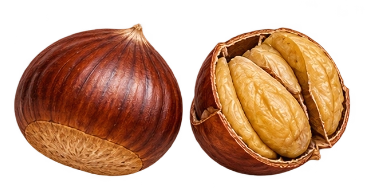
The thin inner skin often folds into the nut and splits it into several pieces
Size
Usually smaller
Peeling
Fiddly, because bits of bitter skin hide in the folds
Best for
Roasting, soups, drying, flour, jam and crème de marrons
Premium chestnut
Edible
In French
Marron
Tree
Sweet chestnut (Castanea sativa), from selected cultivated varieties
Inside
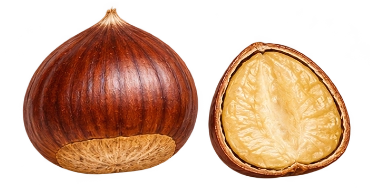
Almost always one whole nut; growers call a variety a marron when fewer than 12% of its nuts are split
Size
Usually bigger
Peeling
Easy, it comes out in one piece
Best for
Roasting, marrons glacés and whole cooked chestnuts in jars
The real difference is on the inside. Every chestnut is wrapped in a thin, bitter inner skin, and in many chestnuts it folds right into the nut and splits it into pieces. Growers call a variety a marron when fewer than 12 percent of its nuts are split that way. That one-piece shape is why a marron peels so much more easily, and why only marrons can be candied whole into marrons glacés.
You’ll often hear that a marron grows alone in its spiky case while châtaignes come in twos and threes. Marrons do tend to be bigger and fewer per case, but the definition growers and confectioners actually use is the one about what’s inside the nut.
For centuries, chestnuts were seen as food for the poor, and marron sounded rather more refined, so the word stuck to the nicer products: crème de marrons (sweet chestnut spread), purée de marrons (plain chestnut purée) and marrons chauds (hot roasted chestnuts sold on the street). For example, the famous and delicious Clément Faugier’s crème de marrons from the Ardèche lists châtaignes in its ingredients while it’s called crème de marrons. So here’s my tip: whichever word you see on a French label, just read “chestnut” and you won’t go far wrong.
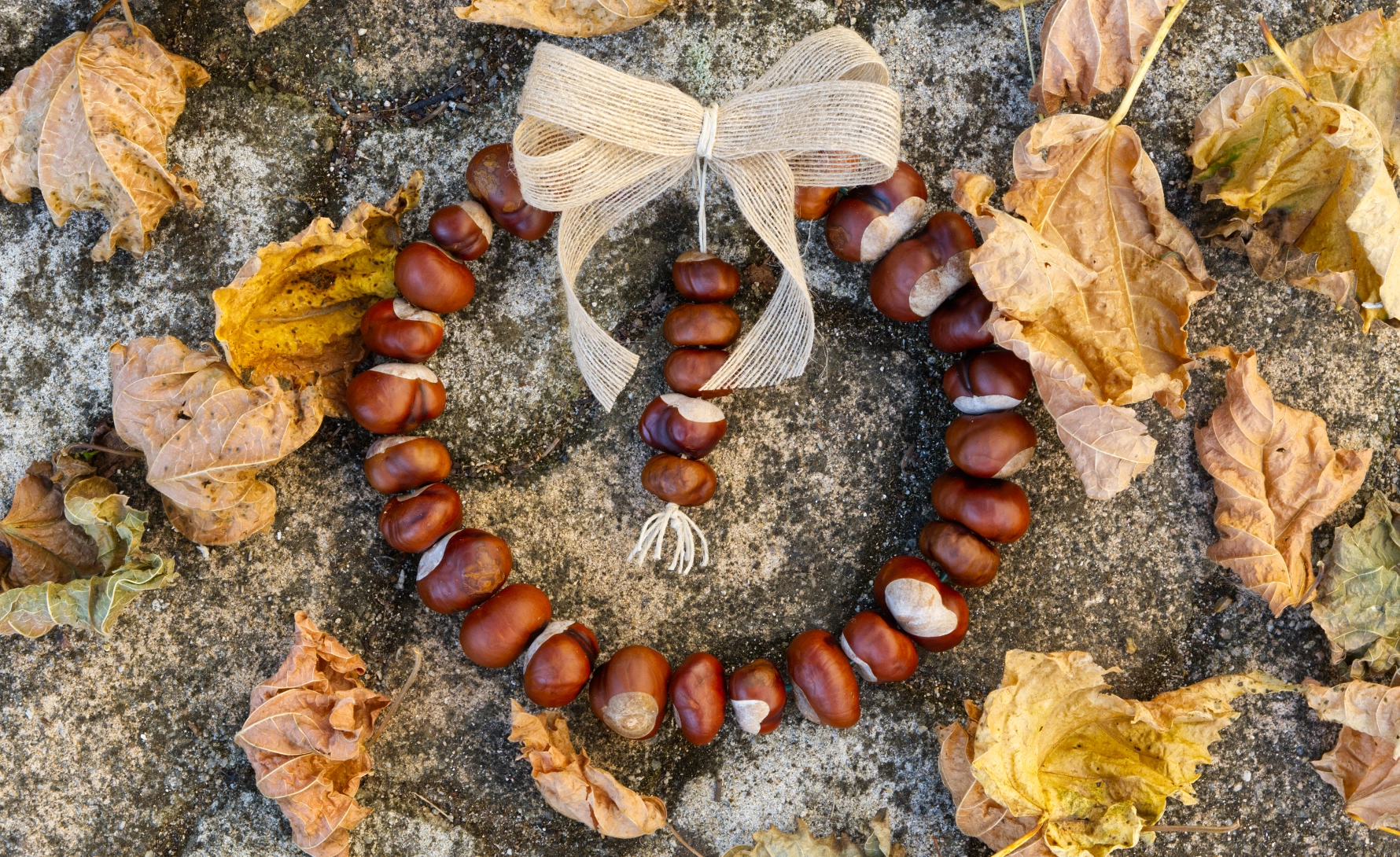
Horse chestnuts vs sweet chestnuts
This bit is more serious. The shiny nuts kids collect in the park, conkers to the British and close cousins of the buckeyes Americans know, come from a completely different tree, in a different botanical family altogether. The French call that tree the marronnier d’Inde and its nuts marrons d’Inde, which is shorten to “marron”. Isn’t that confusing? I know, it took me a while myself to understand what people meant.
And it’s also why you’ll read online that the “real” marron is the horse chestnut, but that it only half true. Both the Académie française and the Larousse dictionary define a marron first as the edible fruit of certain sweet chestnut varieties, and the horse chestnut second. So in France, the same word can mean a fancy Christmas sweet or something that will make you properly ill.
And ill is the right word. Horse chestnuts contain esculin and saponins such as aescin, which can cause nausea, vomiting and stomach upset, so they’re strictly for looking at or to make autumn decorations. Luckily, once you know what to look for, telling them apart is easy.
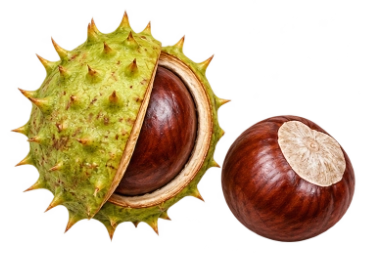
Horse chestnut / Buckeye / Conkers
Toxic
In French
Marron d’Inde, often just called “marron”.
Bur
Thick leathery husk with a few short, stubby spikes, sometimes smooth
Nuts per bur
Usually one, occasionally two
Shape
Round and glossy, no point, no tuft, a large pale scar.
Leaves
Hand-shaped, five to seven leaflets from one stem
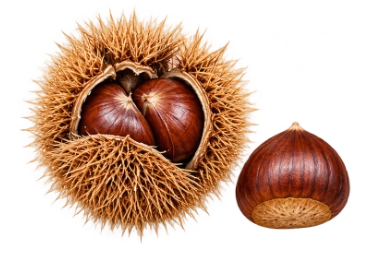
Sweet chestnut
Edible
In French
Châtaigne, or marron for the premium varieties.
Bur
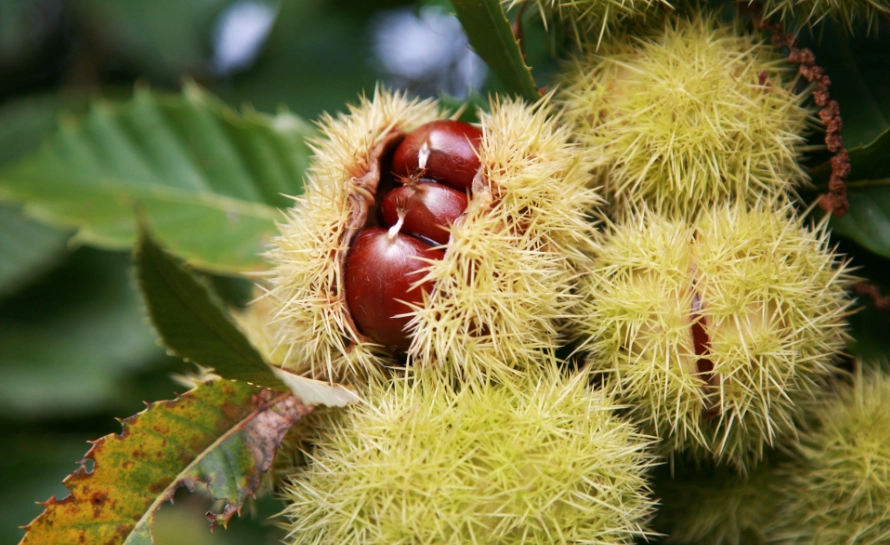
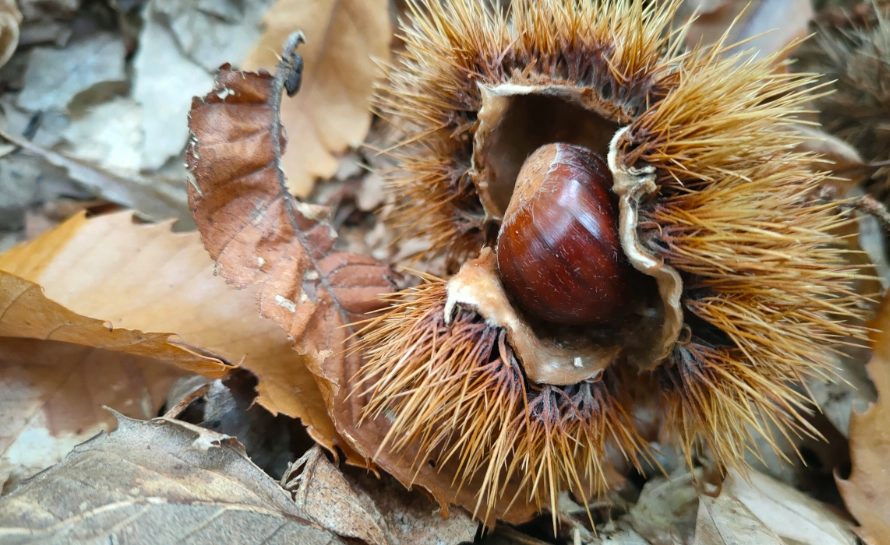
Dense, fine, sharp spines, like a hedgehog
Nuts per bur
Usually two or three
Shape
Flat on one side, with a pointed tip ending in a little tuft.
Leaves
Single long leaves with saw-tooth edges
And water chestnuts?
Despite the name, they aren’t chestnuts and they aren’t even nuts. Those crunchy white slices in a stir-fry come from the underwater corm of a water plant. Lovely in their own way, but they don’t belong in this story.
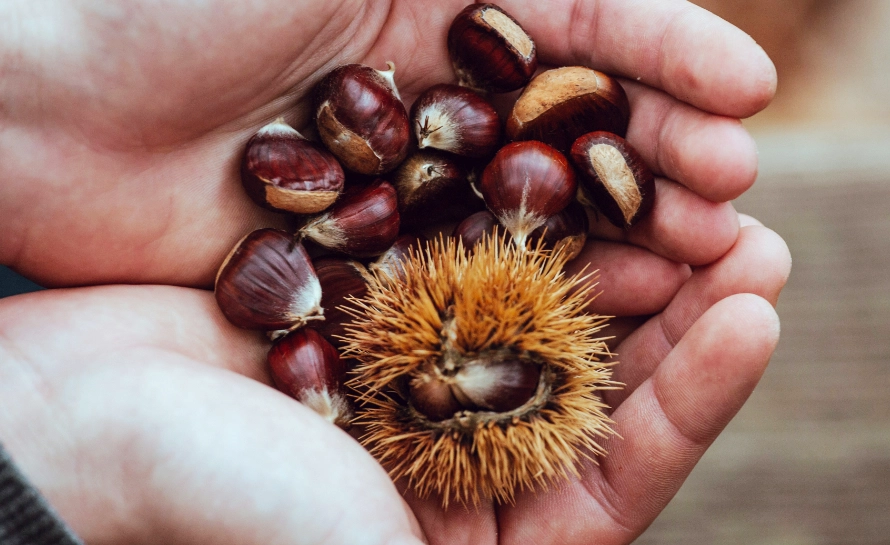
Types of chestnuts: varieties and French AOPs
Around the world, you’ll come across different kinds of chestnuts. The European sweet chestnut (Castanea sativa, also sold as Spanish or Italian chestnut) is the French one. Chinese and Japanese chestnuts, grown in China, Korea and Japan, turn up in American and Asian grocery stores, while the native American chestnut has become rare. Plenty of modern orchards also grow European and Japanese hybrids, which cope better with disease and give lovely big nuts.
In France, though, the fun is in the regional detail. The Ardèche alone counts more than 65 traditional varieties, grafted and selected over generations.
The three chestnut AOPs
France protects three chestnut products with an Appellation d’Origine Protégée (AOP), the same system that looks after Roquefort and Champagne.
Châtaigne
d’Ardèche
Châtaigne des Cévennes
Farine de
châtaigne corse
Where
188 villages in the Ardèche, plus 9 in the neighbouring Gard and Drôme
Mainly Gard, Hérault and Lozère
Corsica
Protected
AOC 2006, EU AOP 2014
EU AOP 2023
AOC 2006, EU AOP 2010
What it covers
Fresh chestnuts, dried chestnuts, flour, from 65 traditional varieties
Fresh chestnuts, dried chestnuts, flour, from 30 traditional varieties
Flour only, from local Corsican varieties
Taste
Notes of brioche, milk bread, squash, sweet potato and honey
Supple texture, with honey, warm milk, sweet potato and violet
Very fine, sweet and biscuity
The Ardèche is the heavyweight. It grows roughly half of France’s chestnuts, and the whole chain, from orchard to crème de marrons, purée and flour, happens right there. The Cévennes is tiny and artisanal by comparison, with around 120 tonnes sold in 2022, which makes finding them all the more satisfying.
I love how the producers describe the tasting notes. Brioche and violets from a chestnut sounds like a wine label and poetry, don’t you think?
French chestnut varieties worth knowing
Here’s something I hold in high regards: over centuries, French growers didn’t just pick varieties that grew well on their particular slope, they picked them for what they’d end up as. Some chestnuts are big and sweet for roasting, some peel in one perfect piece for candying, some are tiny but sugary enough for jam, and the ones that split into pieces go off to be dried and ground into flour, where their shape doesn’t matter one bit.
If you’re ever at a French market or a chestnut festival, this is what to ask for.
Usage
Variety
Why
Roast them or eat them fresh
Bouche Rouge, Comballe, Bouche de Bétizac, Marigoule
Big nuts with a sweet taste. Bouche Rouge is the Ardèche favourite for roasting, while Bouche de Bétizac and Marigoule are modern hybrids grown for their size
Get the first chestnuts of the year
Précoce des Vans
A southern Ardèche marron that ripens very early, around mid-September
Make marrons glacés
Bouche Rouge
Around 90 percent of its nuts are whole marrons with no inner divisions, and it keeps very well
Make jam or chestnut spread
Comballe, Pourette
Comballe is the base for Ardèche chestnut jam, and the small Pourette is so high in sugar that it’s been used for jam since peeling machines took the fiddly work out of it
Dry them or make flour
Corsican varieties like Insitina, Tricciuta and Nucella, plus any chestnut that splits inside
Once a chestnut is dried and ground, it doesn’t matter whether it comes out whole, so the divided ones go here
The Cévennes AOP alone lists 30 varieties, with wonderful names like Figarette, Pellegrine and Peyrejonte. It’s a bit like heirloom apples, where every valley swears its own is the best, obviously.
When chestnuts are in season, and how to buy and store them
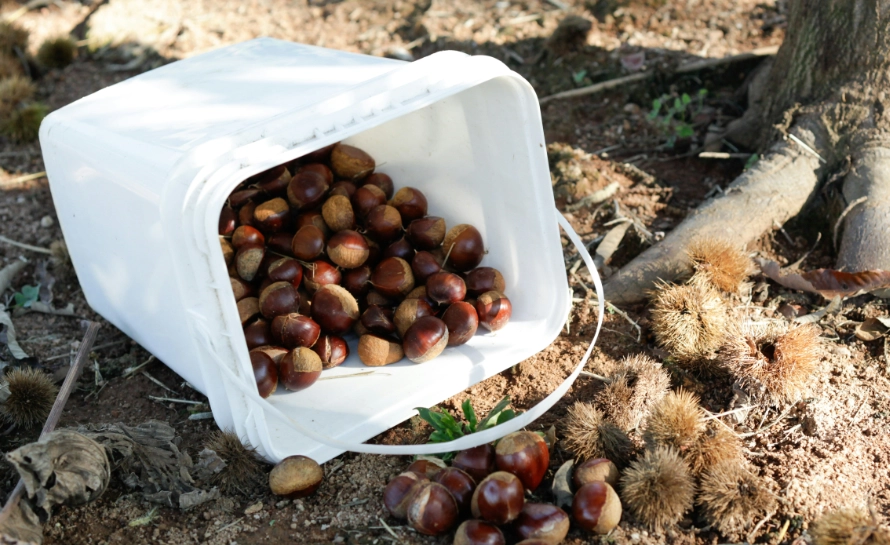
In France, the earliest varieties start falling around mid-September and the harvest carries on into November.
Choosing good fresh chestnuts
Pick one up and weigh it in your hand. A good chestnut feels heavy for its size and has a glossy shell. When pressing gently: a tiny bit of give between the shell and the nut means it has been properly cured and is at its sweetest, while a rock-hard one could do with a little more time in the fridge. Obviously skip the ones with tiny round holes, because a little worm got there before you did. Shells that feel soft and hollow, or nuts that rattle, mean the flesh has dried out inside.
If you’ve gathered your own, try the old water trick. Drop them all in a bowl of water, and the floaters (usually dried out, or with a lodger) go on the compost, while the ones that sink are your keepers.
Storing fresh chestnuts
This is where most people go wrong. Fresh chestnuts are around half water, so they behave more like vegetables than nuts. Leave them in the fruit bowl and within a week or so they’ll have dried out or gone mouldy.
- In the fridge: keep them in a paper bag or a perforated plastic bag in the vegetable drawer and use them within a couple of weeks. They even get sweeter as they rest, because the cold slowly turns some of their starch into sugar.
- In the freezer: freeze them raw in their shells and they’ll keep for several months. Cooked, peeled chestnuts freeze well too, which is a lifesaver before the holidays.
- Dried: the old French way. Dried chestnuts last for months in a sealed jar and just need an overnight soak before cooking.
And if you’d rather skip all of that, vacuum-packed roasted chestnuts sit happily in the cupboard for months. More on those further down.
How to cook chestnuts: roasted, boiled, dried or ready-cooked
There’s more than one way to cook a chestnut, and each one suits a different job. Roasting is for eating them hot, straight out of the shell, boiling is the easier route when they’re heading into a soup, a purée or a dessert, and dried or ready-cooked chestnuts let you skip the peeling altogether. Here’s what you need to know about each one.
Roasted chestnuts
Roasted chestnuts are where it all starts. In winter you’ll still find “marchands de marrons chauds” in bigger cities, roasting them over braziers outside and selling them hot in paper cones. That’s the way I first encounter this lovely ingredient as a kid, on the streets. It’s that gorgeous smell that does most of the selling really, you have to stop. For the full method and timings, head over to my roasted chestnuts recipe.
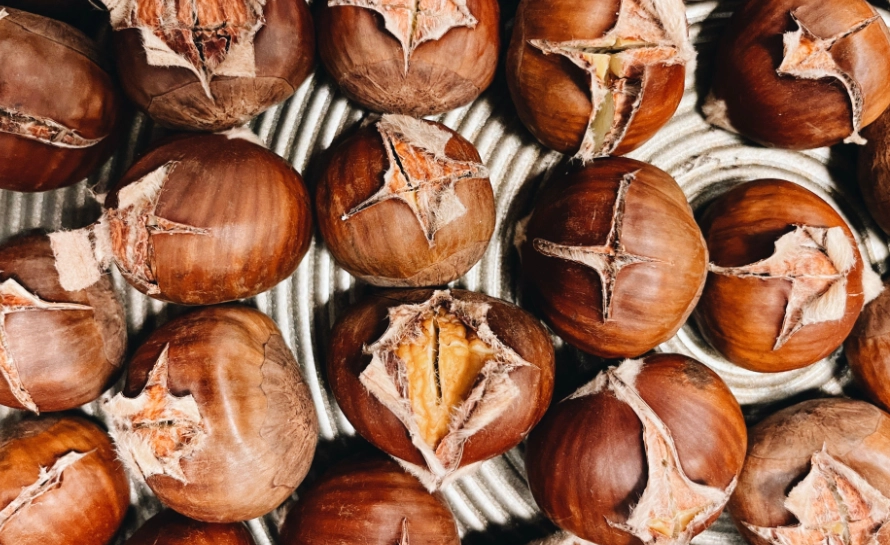
One thing I’ll repeat here, because it matters: always score your chestnuts before they go near any heat. Steam builds up inside the shell and an unscored chestnut can burst with a bang that will make you jump out of your skin unnecessarily.
A small curved knife makes scoring much easier and safer, since chestnuts are hard, round and love to roll away from a big kitchen knife. A chestnut knife or small curved paring knife is the easiest way to do it. If you want the proper French experience, a “poêle à châtaignes“, a long-handled pan with holes in the base, lets the flames reach the shells over a gas hob, a wood fire or a barbecue. It’s a pan that does one job, I’ll admit, but it’s very cozy on a open fire outside with friends!
Boiled chestnuts
When chestnuts are going into a soup, a purée or a dessert, most French recipes start by boiling them, mainly because it makes peeling a big batch much easier. That said, roasting works just as well and gives a deeper, toasty flavour, so if you love that smoky taste in your velouté, roast them first. It’s really down to what you prefer.
This is also my impatient method when I don’t fancy putting the oven and want only a few to eat as a snack. Score the chestnuts, drop them into a pan of salted boiling water and let them simmer until a knife slides in easily, usually 15 to 30 minutes depending on their size. Fish out three or four at a time and peel them while they’re hot, leaving the rest in the water so they stay warm. A folded tea towel will save your fingertips, although mine never seem to learn!
Peeling chestnuts for a recipe
When the chestnuts still need cooking in a dish, like a velouté or a pan of chestnuts with vegetables, it’s easier to peel them first and cook them afterwards:
- Score each chestnut across the rounded side.
- Simmer them briefly, just until the shell and the inner skin start to loosen.
- Peel a few at a time while hot, taking off the shell and every last bit of the papery brown skin, which is bitter.
- Simmer the peeled chestnuts gently in vegetable stock or milk until tender.
I won’t pretend peeling a kilo of chestnuts is quick. It’s the perfect job to hand to whoever wanders into the kitchen asking when dinner will be ready.
The shortcut: ready-cooked chestnuts
Outside chestnut season, I personally happily reach for vacuum-packed or jarred whole roasted chestnuts, and there’s no shame in it at all. In France they’re sold as “marrons entiers au naturel”, peeled and cooked or roasted with nothing added, and they turn a two-hour job into a two-minute one. Just make sure you pick plain, unsweetened ones. This is what most French home cooks use as you can find these in every supermarket here.
Dried chestnuts
Dried chestnuts (châtaignes sèches) come already peeled, which makes them a bit of a secret weapon. Soak them overnight, then cook them just as you would fresh ones, simmering gently until tender. They’re what the traditional Cévennes chestnut soup, bajanat, is made with. In France, dried chestnuts are one of the three products protected by the Ardèche and Cévennes AOPs, and you’ll find them from local producers who still dry them in clèdes before shelling them. Many of the dried chestnuts sold in supermarkets and online are imported, though, so check the label if you want French ones.
Cooking and baking with chestnut flour
If you can’t get fresh chestnuts, chestnut flour is the easiest way to bring their flavour into your kitchen. It’s naturally sweet and nutty, and it works in both sweet and savoury recipes.
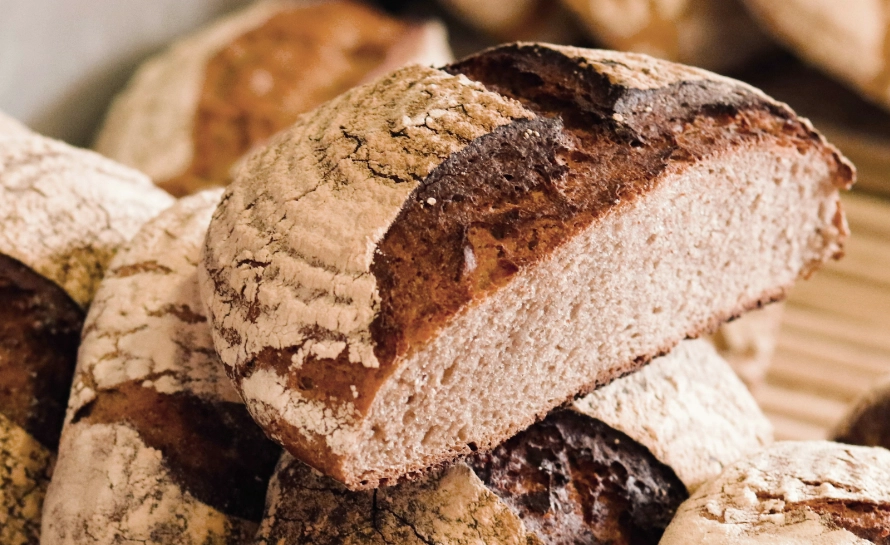
It behaves quite differently from wheat flour, though. Chestnut flour has no gluten, so on its own it won’t rise or give you that stretchy, airy crumb. That’s why most French recipes blend it with wheat flour. For bread, keep chestnut flour to around 30 percent of the total, because the more you add, the denser the loaf gets. Cakes, crêpes and pancakes are more forgiving, and you can go up to half and half. Used alone it is obviously 100% glutenfree and works in flans, thin flatbreads like the Corsican nicci, and polenta-style dishes like pulenda.
A few things worth knowing:
- Sift it. Chestnut flour clumps easily, and those little lumps don’t always disappear in the mixing bowl.
- Add a little moisture. Chestnut flour can make bakes dry, so a spoonful of yoghurt or a splash more milk helps.
- Store it well. Keep it somewhere cool and dry, and once the bag is open, many producers suggest the fridge or freezer.
French chestnut products you should know
Walk into any French supermarket in November and you’ll find a whole shelf dedicated to chestnuts. A few of these are worth tracking down wherever you live.
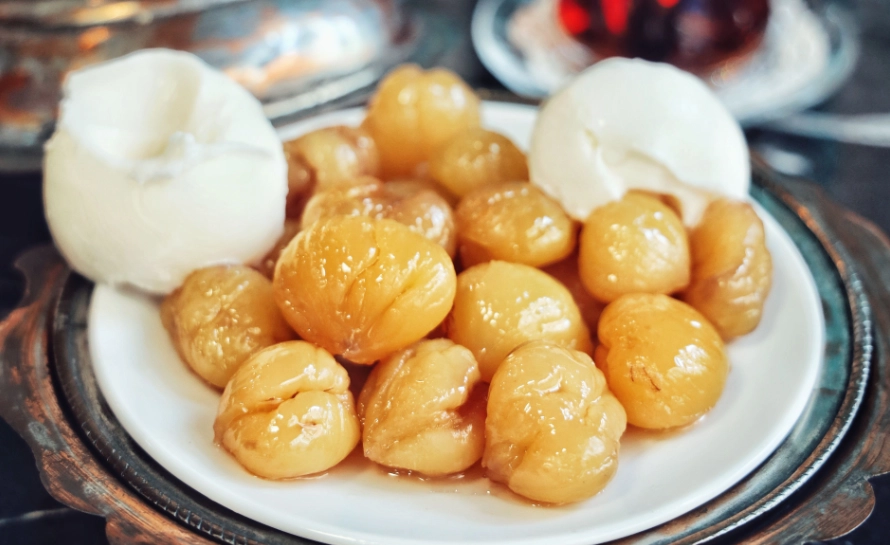
Marrons glacés (candied chestnuts)
Marrons glacés are the posh end of the chestnut world. In France they’re a Christmas tradition, often wrapped one by one in gold foil and tucked into elegant boxes that make you feel very grown-up. French cookbooks were already describing candied chestnuts in the 17th century, but it was Clément Faugier who opened the first marrons glacés factory in Privas, in the Ardèche, in 1882.
Making them takes patience. Whole peeled marrons are candied over several days in a sugar syrup that gets a little stronger each time, then finished with a thin glaze. What you get is soft, almost fudgy, very sweet and scented with vanilla. Only marron varieties will do, because a chestnut split into lobes would fall apart in the syrup, and plenty break anyway, which turns out to be very good news (keep reading).
They’re expensive, so they’re best enjoyed one at a time with a coffee rather than by the handful, if you can find the willpower.
Crème de marrons
If French chestnuts had a mascot, it would be the little tin of Clément Faugier crème de marrons, with its old-fashioned label. In 1885, Faugier was left with a pile of broken marrons glacés he couldn’t sell, so he crushed them with chestnut purée, sugar, syrup and vanilla, and accidentally created a French classic. It’s still made in Privas today.
It’s a thick, sweet chestnut spread, and In France it gets stirred into fromage blanc or yoghurt, spread on crêpes and toast, or eaten straight off the spoon when nobody’s watching, that would be me. It’s also the base of Mont-Blanc and plenty of Christmas desserts.
Just don’t mix it up with its cousins. Purée de marrons is plain, unsweetened chestnut purée, perfect for soups, savoury dishes and baking where you want to control the sugar. Confiture de châtaignes is chestnut jam, and in the Ardèche it’s traditionally made with the Comballe variety.
Chestnut flour (farine de châtaigne)
Made from dried, peeled chestnuts ground very finely, chestnut flour is naturally sweet and nutty, with a soft beige colour.
Miel de châtaignier
Chestnut honey is made by bees feeding on the trees’ flowers, which bloom in June and July, so funnily enough there isn’t a single chestnut in it. It’s dark amber to brown, with a strong, woody, slightly bitter taste that people tend to either love or find far too strong. It’s lovely drizzled over a sharp goat’s cheese.
Chestnut drinks
In the Ardèche, the local apéritif is the castagnou, a kir made with one part chestnut liqueur to two parts dry white wine. In Corsica, Pietra is an amber beer brewed with Corsican chestnut flour in Furiani since 1996. You can find this beer in supermarkets in France. But if you’re visiting Corsica or the Ardèche, try these two and thank me later.


How the French eat chestnuts
Chestnuts move between sweet and savoury very easily, and French cooking takes full advantage of that. I personally can never choose if I prefer one or the other, it’s all so delicious!
Savoury chestnut dishes
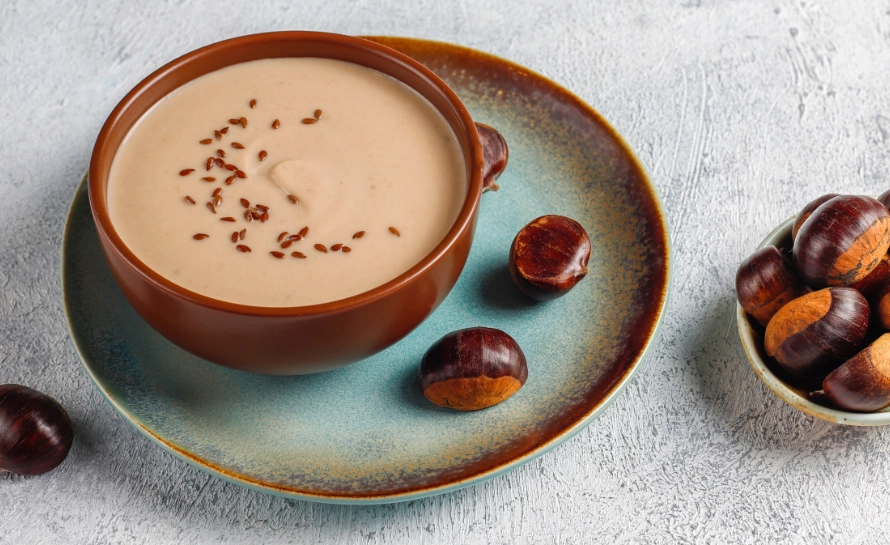
Velouté de châtaignes
Chestnut soup is the great French autumn starter, and one of my favourite ways to eat them. Chestnuts are simmered with onion or leek in vegetable stock, blended until silky and finished with a little cream. You can even add a drizzle of walnut oil on top to make it even more elaborated. A heavy cast-iron pot is perfect for this kind of slow, gentle cooking.
Chestnuts with mushrooms
Peeled chestnuts sautéed in butter with wild mushrooms, shallots and parsley make a classic autumn side, and a very happy supper with a fried egg on top.
Chestnuts with winter vegetables
Brussels sprouts, butternut squash, celeriac and parsnips all get along famously with chestnuts. Toss halved sprouts and chestnuts in butter until golden, and you might even win over the sprout haters at Thanksgiving or Christmas.
Chestnut stuffing
Chestnuts, bread, onion, celery, herbs and plenty of butter make a vegetarian stuffing that can hold its own on any holiday table.
Sweet chestnut desserts
Mont-Blanc
A nest of meringue, a cloud of whipped cream, and strands of sweet chestnut purée piped all over it until it looks like a snowy mountain. The Paris tea room Angelina is famous for its Mont-Blanc version.
Bûche de Noël
Chestnut is a popular French flavour for the Christmas log, often made with crème de marrons.
Crêpes à la crème de marrons
A classic sweet crêpe filling in France, and as simple as spreading it on!
Fromage blanc with crème de marrons
About the simplest French dessert there is: a spoonful of crème de marrons swirled into fromage blanc. Thick Greek yoghurt works if you can’t find fromage blanc.
Regional specialities
Cévennes
Bajanat, a soup of dried chestnuts soaked overnight and simmered in water, sometimes finished with milk or wine.
Corsica
Pulenda (or pulenta), a dense chestnut flour polenta served in slices with fried eggs and fresh brocciu cheese, plus fritelli castagnine (chestnut flour fritters) and nicci (thin chestnut flour wafers cooked between hot irons).
Limousin
Les blanchies, chestnuts stripped of both skins (the inner one rubbed off in the pot with a wooden cross-shaped tool), then steamed on a bed of potatoes. They were the traditional mid-morning meal, eaten by adults with soup and by children with warm milk.
Ardèche
Crème de marrons, obviously, plus chestnut flour cakes and chestnut soups.
Chestnut festivals in France
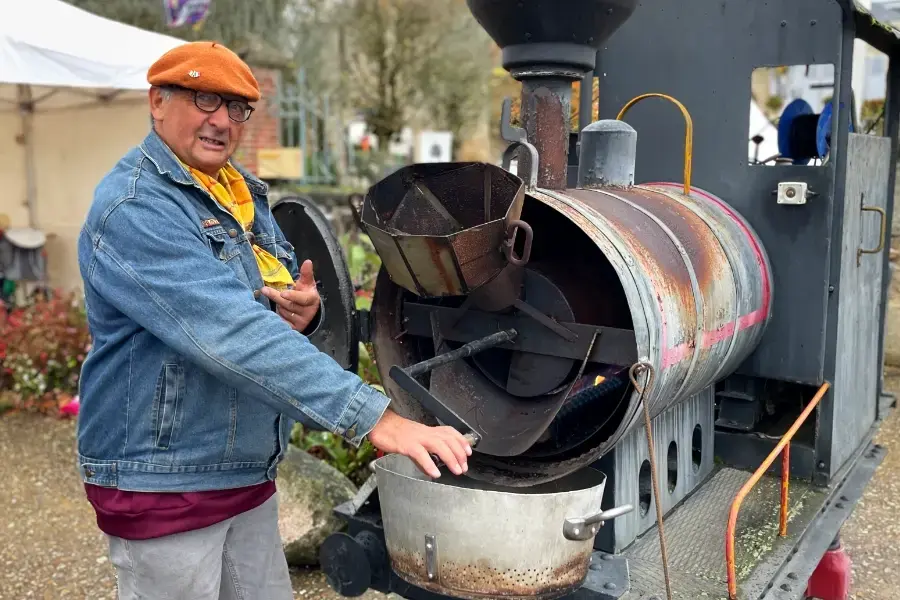
If you’re in France in autumn, a chestnut festival is hands down the best way to eat chestnuts. Many villages hold one between October and early December, and they tend to follow the same happy formula: chestnuts roasting over wood fires, local producers selling everything from flour to jam and marrons glacés, music in the streets and a lot of people walking around with sooty fingers.
You’ll find them all over the chestnut regions, from the Ardèche, where a whole string of “village fêtes” runs through the autumn, to Collobrières in the Var, which celebrates over three Sundays in October, and Corsica, where the December fair in Bocognano is a big date in the island’s calendar. Closer to home for me, the Indre has its own at Éguzon chestnut festival and I go every year if I can to eat as many as my stomach can handle with fresh pressed applejuice!
What to drink with chestnuts
Talking about applejuice, in France, hot roasted chestnuts and a glass of cider make a perfect match. It’s a classic autumn combination, and in parts of Brittany, people will tell you it’s not so much a tradition as simply obvious.
And there’s a good reason it works. Roasted chestnuts can feel a little dry, starchy and even slightly astringent in the mouth, so you want something refreshing, fruity and a touch sweet to balance them, which is exactly what a “cidre doux” does. The bubbles help too.
A quick note for American readers: French cidre isn’t the cloudy apple juice you’d call cider in the US. It’s fermented, alcoholic and usually sparkling, which is what Americans call hard cider. For chestnuts, go for a cidre doux, the sweeter and lighter style, rather than a dry cidre brut.
In wine country, the other traditional choice is “vin bourru”, a cloudy, slightly fizzy new wine that’s still fermenting and only around 3 to 5 percent alcohol. It’s only around for a few weeks after the grape harvest, and in the southwest, evenings of roasted chestnuts with vin bourru are a proper local tradition.
FAQ
What is the difference between a châtaigne and a marron?
Both are French words for chestnut, and both come from the sweet chestnut tree. Growers call a variety a marron when fewer than 12 percent of its nuts are split into lobes by the bitter inner skin, so it peels in one whole piece. Everything else is a châtaigne. Marrons are the ones used for marrons glacés.
Are horse chestnuts edible?
No. Horse chestnuts (conkers) and their American cousins, buckeyes, are toxic and cause nausea, vomiting and stomach pain. Sweet chestnuts grow in very spiny burs, two or three at a time, and have a flat side with a pointed, tufted tip. Horse chestnuts are round and glossy, with no point and no tuft.
Do you have to score chestnuts before cooking them?
Yes, every single time. Steam builds up inside the shell as they cook, and an unscored chestnut can burst, sometimes loudly. A cross or a long slit through the shell on the rounded side does the job.
How do you store fresh chestnuts?
Keep them in the fridge in a paper or perforated bag and use them within a couple of weeks. For longer, freeze them raw in their shells for several months. Fresh chestnuts are around half water, so they spoil quickly at room temperature.
What are candied chestnuts?
Candied chestnuts, or marrons glacés, are whole peeled marrons candied over several days in sugar syrup that gets stronger each time, then glazed. They’re a French Christmas tradition, and Clément Faugier opened the first marrons glacés factory in Privas, in the Ardèche, in 1882.
What is crème de marrons used for?
Crème de marrons is a sweet chestnut spread. The French stir it into fromage blanc or yoghurt, spread it on crêpes and toast, and use it in desserts like Mont-Blanc and bûche de Noël.
How do you use chestnut flour?
Chestnut flour has no gluten, so for breads, cakes and crêpes it’s usually mixed with wheat flour. Keep it to around 30 percent in bread; cakes, crêpes and pancakes can go up to half and half. Sift it first, because it clumps.
Over to you
Chestnuts take a bit of effort, I’ll give you that, between the scoring, the waiting and the peeling. But that first warm, floury chestnut on a cold evening makes up for all of it, and I can’t think of many seasonal rituals that have stayed so unchanged.
If you’ve never cooked them, start simple with a batch of roasted chestnuts and peel them while you chat. If you’re already a fan, try a spoonful of crème de marrons on your next crêpe, or swap some of your usual flour for chestnut flour and see what happens. I suspect you’ll be hooked just like I am!
Now I’d love to know how you eat yours. Are you a hot-chestnuts-from-the-street person or a crème-de-marrons-straight-from-the-tin person? Have you been to a chestnut festival, or (be honest) ever mixed up a chestnut and a conker? Tell me in the comments!
This post may contain affiliate links. If you buy through them I earn a small commission at no extra cost to you, and it helps keep this blog running. Please read my disclosure policy for more information. I am grateful for your support.